Monday, September 10, 2012

Potato Salad German Style


What a hectic summer I've had!  With practically everyone living in my home at one point during the summer (excepting the Aged Parents, whom I traveled regularly to visit), it seemed like one long party!  Picnics and parties in the summer always mean, to me, German Potato Salad.  My mother’s family passed down this recipe to me and my sisters:
     A few potatoes, boiled whole and peeled while hot, then sliced bite-size
     An onion or two, chopped quite small
     A few celery stalks, chopped quite small
     Some bacon, fried till crispy, drained on paper towels and crumbled
    Whisk vinegar into the hot bacon fat, and pour over the mixed vegetables.  Stir well, salt and pepper to taste, and serve warm.

You can go pretty far wrong with that recipe, unless you know how it should taste!  But once you get a feel for the proportions, you can make this in different quantities.  A word of warning: Ten pounds of boiled potatoes really warm up your kitchen if you prepare this for the Fourth of July picnic.  And in the photo above, the accompanying pork chop is topped with a dollop of fresh herb-butter.

I’ve tried making some variations on this basic recipe, such as replacing the bacon fat with olive oil (too strongly Italian flavored) or canola oil (too bland).  It works pretty well to drain away the bacon fat down to just the darkest portion, and then add canola oil to achieve the desired quantity of fat.

Also, I’ve used different vinegars, notably balsamic, with varying results.  I still think cider vinegar works best, but maybe that’s because it gets that childhood-comfort-food taste.

You can also add other vegetables.  Parboiled green beans and shredded Savoy cabbage were my favorites, and both improved the nutrition quotient.  Spinach also works well.

But no matter how I play with this recipe, I always get rave reviews.  Many Americans have only ever had a potato salad made with mayo, and if you don’t like mayo, you’ve written off potato salad.

Living in Germany, I’ve discovered that my family’s recipe is different from the traditional one in its use of celery.  Germans seem to prefer cooking with the rootball, rather than the stalks of celery’s.  Most servings of Warm Kartoffelsalat in Germany come topped with chopped parsley, dill or chives.  Chopped fresh herbs may have been outside my German ancestors’ capability.

I’ve also learned that potato salads are not served only during hot weather in Germany, but year-round.  Another mayo-free German Potato Salad, known as Cold Potato Salad, is often served as a side dish year-round.  Simply, one boils the potatoes in their skins, then peels and slices them while hot.  Mix in a finely chopped onion, and some chopped bacon if you wish. Mix together two cups of broth (beef is delicious here) with vinegar to taste, and pour over the potatoes and onions while hot.  Mix and leave to sit for half an hour, and pour off any excess liquid.  Drizzle with olive oil, and season to taste with salt and white pepper, sprinkle with chopped herbs and serve cool. 


Again, in Germany I’ve encountered variations on this recipe, some including capers, or mustard for flavor, or using beer in the liquid, or thickening the liquid with flour.  This last measure is unnecessary if you use a starchy potato or one like Yukon Gold, which is only slightly starchy.  Waxy potatoes such as new potatoes don’t work well in either hot or cold German Potato Salads.

Both of these German Potato Salads are served at moderate temperatures, neither hot nor ice-cold.   The flavors develop more fully at a moderate temperature, and are less of a shock to the palate.

At home in the US over the summer, my husband and I wanted to eat foods we couldn’t get easily or inexpensively in Germany (Mexican!  Barbeque!  Fish!), but the family required some German food to make up for their not being able to join us in Germany.  A few servings of either hot or cold German Potato Salad went a long way towards compensating them.  And if a few pork chops or sausages also came their way, all the better!

Wednesday, June 6, 2012

Dutch Treat


We thought the train ride from Karlsruhe to Amsterdam was a treat!  The track wound along the Rhine, giving us views of old half-timbered German towns on one side, and castles perched on precipices above the river on the other.  


But that was just the beginning!  In Amsterdam, Rotterdam, and The Hague, we absorbed every Vermeer and Rembrandt to be seen, and studied dozens of other great Dutch Masters.  In the Keukenhof Garden, we saw hundreds of thousands of flowers, mainly tulips, but also daffodils and hyacinths in stunning sweeps of color.  


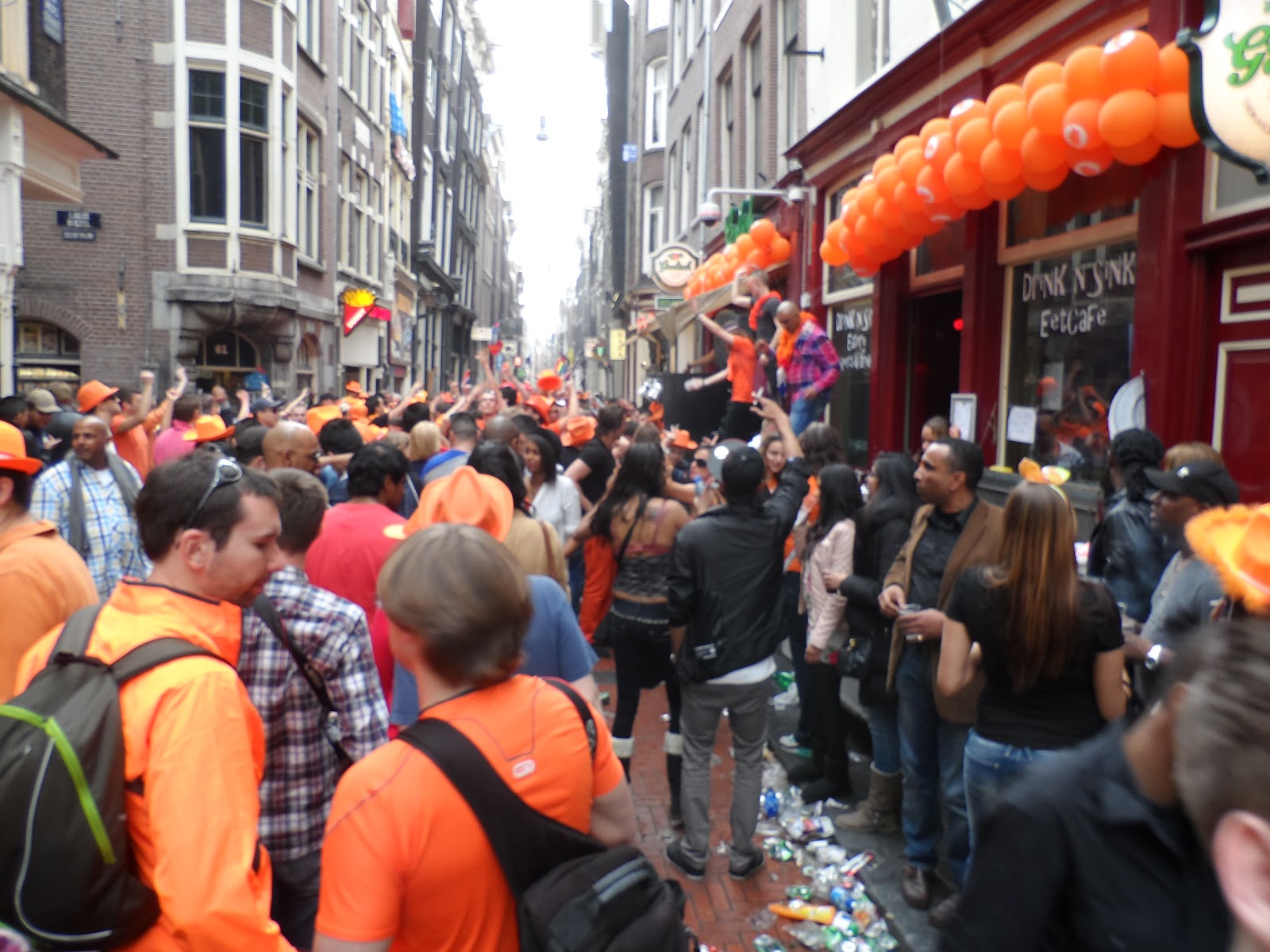
And in our last 24 hours in Amsterdam, we witnessed the ordinarily very sociable Dutch putting on their best party possible to celebrate their beloved Queen.


I have put off writing about our trip to the Netherlands far too long.  When we arrived back in Karlsruhe, we suddenly realized it was time to think about packing up, and at the same time I was invited to share my blog on my hometown online community newspaper.  Those were both things I had to throw myself into, or they wouldn’t get done at all!  That’s my feeble excuse.

Our trip to the Netherlands lasted five nights.  We spent the first night in Amsterdam (at the worst room in a terrible hotel), and visited the Rembrandt House and the Rijksmuseum the next day.  Ordinarily, it would take an entire day to see the Rijksmuseum but it is under major reconstruction right now, and so just the very cream of the collection is on view.  We hugely enjoyed the progression of the Dutch mastery of realism by so many 16th and 17th century artists.  When we found ourselves in front of Vermeer’s The Kitchen Maid, eternally pouring milk, time stopped.  I have no idea how long we gazed at that painting, but eventually we turned away, full.


We took the train (an hour) to Rotterdam, which is entirely modern.  The city was leveled by the Nazis, even though the Dutch had already surrendered.  We found it a fun and lively city.  We spent the day at the Boijmans Museum near our nice little hotel.  On display was “The Collection Enriched”: the Museum had borrowed from several other Dutch museums (such as the Rijksmuseum) and the exhibit swept us from Medieval Europe up to 20th Century, showing us how the Italian and the Dutch painters of the Golden Age urged one another on to greater achievements.  We were so sated by all this beauty that we never strolled across town to see the famous Cubic Houses.  We just didn’t need to!  Our most memorable meal was in Rotterdam where we had different species of smoked fish with a creamy horseradish accent; our favorites were butterfish and, to our surprise, eel. 

We took the train to The Hague the next day.  The Mauritshuis Museum is home to more Vermeers but proved to have been closed for renovations just days before.  The best of its collection, except the luminous Girl with Pearl Earring (which we were told had gone on tour), had moved over to the Municipal Museum (don’t ask for the Dutch name, it’s mostly vowels).  This temporary home was an undistinguished building, strongly reminiscent of high schools built in the late 1950s.  

Once more, just the cream of the collection was on display, but it was wonderful.  Breughel, Hans Holbein, Jan Steen, Frans Hals, Rembrandt, and other great Dutch painters—and then, there she was, gazing at us! We gazed back at the Girl with the Pearl Earring, drinking in every brush stroke, each suggestion placed exactly so, and then drew back, only to be drawn in once again by the open gaze of the Girl.  Sated, silenced, we made our way back to the Central Train Station and headed back to Amsterdam.


Nothing was silent when we got to our hotel at the edge of central Amsterdam.  Queen’s Day apparently begins  at sundown the evening before, and ends by nightfall 24 hours later.  And what a party!  Rock bands, beer and gin dispensers, and outlandish costumes featuring bright orange, in honor of the Royal House of Orange. 


Scary rides and a ferris wheel, as well as food and beer sellers, were set up in Dam Square.  At night, it made a beautiful sight.


The Dutch are the most accepting culture I have encountered anywhere.  They’ve been tolerant of differences in language and religion for centuries, perhaps because of the persecution they suffered under the Spanish when accidents of royal marriage in the 15th and 16th centuries brought Catholic rule to this Protestant land.  The Dutch played host for ten years to English Pilgrims including two of my Pilgrim ancestors, Isaac Allerton and Thomas Blossom, who eventually left for Plymouth partially because they rejected the influence of the Dutch on their children.  Today the Dutch include refugees from many nations, have legalized (and thereby cleaned up and collected taxes from) prostitution and marijuana, and provide equal rights for the LGBT community.  We sat in at an outdoor cafe that evening, enjoying a Heineken, and the endless variety of people who are really glad to be Dutch.


We missed a lot of Queen’s Day the next morning, arising early for our tour of the Keukenhof Garden.  It’s only open for two months each year, but still attracts more tourists than any other single Dutch site.  Rightly so!  It’s breathtaking.  My Dear Husband claims that we only went because it’s nearly our anniversary (32nd!) and my birthday (just 39 again), but really, he loves it about as much as I do.


Amsterdam was still partying strong when we returned in mid-afternoon.  Groups danced to bands in the street, boats blasting music and loaded with party-people cruised the canals, and there was trash, everywhere.  


By sundown (which is pretty late on April 30 since Amsterdam is so far north) those who’d partied hardest had collapsed someplace.  When we went out at dawn for our train, the streets had been miraculously swept clean, with just some half-full beers stashed in corners remaining to tell the tale.

Tuesday, May 8, 2012

Alsace Across the Rhine


 We’ve made a couple of very brief visits to Alsace, the region of France right across the border from south-western Germany where we’re living.  Alsace was the area from which my dear husband’s dear mother’s paternal relatives, the Elferts, emigrated in the 19th century.  I posted photos of our visit to Strasbourg in February.  In April, on our drive home from Lausanne, we passed through this region again and stopped to visit Colmar, which is south of Strasbourg.  Colmar was a wealthy and important town from the 15th to the 17th centuries and had trade routes directly to several European cities.


I have a guidebook to France by Rick Steves on my Kindle Fire.  We were very glad of this because our huge “Europe” Lonely Planet guide gives only cursory information about even the largest cities, and hardly notices the smaller towns.  Rick Steves gives plenty of detail on Colmar, even walking us through the medieval center and pointing out buildings of particular interest (not that we followed him; we followed our own instincts and enjoyed what we saw without commentary or trying to read the Kindle screen in daylight).


Colmar blew us away.  Its old center is chockfull of darling half-timbered, dangerously leaning, variously painted little buildings.  I’m having trouble choosing just a few of our photos.  We both had cameras and we could hardly stop shooting.  It wasn't an especially pretty day and began drizzling after a while.  In the sunshine, it must be dazzling.


Alsace was at points in its past more German than French, and its cuisine makes this clear.  It’s a wine region, yes, but Rieslings rather than Burgundies.  Beer is enjoyed in glasses and recipes.  Choucroute Garni is perhaps the most famous of the regional recipes; sauerkraut “garnished” with smoked pork, ham and sausages.  Flammkuchen is the German name for the local thin crusted pizza-like appetizers topped with bacon, cream and onions.  All the bakeries we saw featured Brezeln as though they weren’t equally beloved in Germany!  You’ll understand that we found a lot to love in Alsace.

Not that we could eat all that stuff during our brief visit!  We'd arrived rather late for lunch and in this part of France, regular restaurants close their kitchens between about 2 pm and 5:40 or 6.  As a result, we had to eat in the sort of establishment designed for foreigners who don't understand the need for this type of regulation!  Chefs have to rest, you know.  They can't just keep cooking all day.  Creativity must be restored.

Colmar was still decorated for Easter, which had taken place two weeks before our visit.  We particularly liked these Easter decorations.


Here's a close up of the box over the doorway at the Brasserie des Tanneurs shown above:

Culinarily, and architecturally, I have come to feel that Alsace, Baden-Wurttemburg and northern Switzerland belong to one another almost more than they belong to their own nations.  Alsace speaks French (although I had a hard time understanding them) and Basel speaks German (its very own dialect which apparently few Germans can comprehend), and the Schwabisch dialect of Baden-Wurttemburg is unintelligible to many northern Germans.  The Rhine provides an easy means of commerce among these three areas which has been available since the most primitive times,  promoting strong cultural links amongst whichever tribes dominated each locale.  Of course, I never thought that crossing a man-made border would reveal a completely unrelated way of life, but the cultural integrity of this tri-nation region is particularly striking.  And perhaps that's one reason why we have enjoyed our visits here so much.

Thursday, May 3, 2012

Switzerland and Its Cows


Switzerland is not just noted for its Alps, its chocolates, cheeses, watches and Smurfs (which they think are called Schlumpfs!).  No, Switzerland also has cows.   And as you may know, cows mean a great deal to me.  Of course, they recall for me my happy childhood summers in Vermont.  More than that, the sight of cows floods my being with peace.  These creatures have distilled life down to (well, perhaps, never have progressed beyond) staying alive: eating and processing food, resting and sleeping; and maybe procreating if possible.  Would that I, too, could keep it that simple.  Because I cannot, the sight of live cows (not cartoon travesties) relaxes me like a deep lungful of oxygen.  Therefore, you will have no trouble understanding that my visit to Switzerland in April was joyful.

The cows of Switzerland live luxuriously in emerald green meadows with vistas of snow-capped mountains to contemplate.  Their milk, creamy-rich, is a steady source of income for the Swiss as it forms the basis for their expensive cheeses and chocolates.  This vat is full of cows milk being turned into Gruyere cheese.

As we drove around Switzerland last week, my dear husband had to endure a steady stream of “Look, cows!” exclamations from me.   He even insisted on buying a little stuffed cow for me (her name is Heidi) who went nearly everywhere with us.  Sometimes, she posed with fake cows.  She has a very big silly smile.

Thanks to my dear husband’s wonderful career, we were the guests of some former colleagues of his who unaccountably prefer to live in the middle of Europe and accept a million dollars every year from the Swiss government as a starting point for their scientific research at one of the best technical universities in the world.  The Ecole Polytechnique Federale de Lausanne (EPFL) is only about 40 years old but very well funded and growing fast.  We were put up in a hotel next to the campus where we had this incredible view across Lake Geneva.

Another of Switzerland’s riches is languages, of which it has four.  Well, one of them is really more of a mascot than a communication tool (Romansch is only spoken by like 1% of the nation), but practically everyone speaks two of the following and sometimes all four: French, German, Italian, and English (which isn’t a national language but might as well be).   EPFL was founded so that there would be a technical university in the French-speaking part of the country, in addition to ETH (where Einstein worked) in the German-speaking part.  This was lucky for us, because during our stay we were treated to world-class fine dining, mostly French style.

Lausanne lies along the long north side of Lake Geneva, on hills that rise quickly from the lake shore.  In the city, this topography creates neighborhoods where the front door of a house may be at ground level, but its back door could be on the third floor.  Sometimes, the grade is so steep that there are flights of stairs instead of sidewalks.  You get a real workout walking around here.

In the country villages outside Lausanne, vineyards are terraced along these steep hills.  Some hillsides are so perfect for growing grapes that every square inch is terraced and planted with vines.  

We were able to sample quite a few Swiss vintages as our main host is a connoisseur, and very generous to boot.  We had a lovely meal at his home one night.  I snapped this photo of his view of Mont Blanc from his living room!

As he drove us to his house, he pointed out in a neighboring village the small castle which had briefly been the home of the mystery author, Georges Simenon, who wrote several of his famous “Maigret” procedurals here.  Simenon only rented this little place; he was a successful enough writer to buy a much bigger home north of Lausanne (which I failed to visit).  I was already envious enough of this place.

At the suggestion of our host, we drove about an hour north of Lausanne to visit the town and the castle of Gruyeres.  The Swiss weren’t always carefully neutral.  At one time, they fought battles as bloody as any.   Gruyeres was the scene of attacks from other Swiss cities!  One attack was thwarted when the women of the town tied burning brands to the heads of their goats, and drove them at the sleeping enemy! Eventually, the duke or earl (whatever!) lost the battle of finance:  in deep debt, the castle was taken by the nearby city of Fribourg.


Later, the castle was purchased by a wealthy businessman for his artist brother, who invited his friends in to decorate the music room.  The castle is now used by the nation to encourage art, and to reap millions in tourism. 

Wherever we went, we saw beauty up close, and at a distance; in the city, and away.  Concentrating on staying out of wars for more than a century has allowed the Swiss to focus on the art of living.  The Swiss have refined this art in their husbandry of their land and its products, and in their nurturing of their citizens through generous government funding.  To receive the stamp “Swiss”, and thus be most expensive, all meat and poultry must be free-range, grass-fed, and probably entertained by classical musicians.  The Swiss believe such meat tastes much better than feed-lot animals, but they also know that the animals they consume have enjoyed life as much as their consumers.